

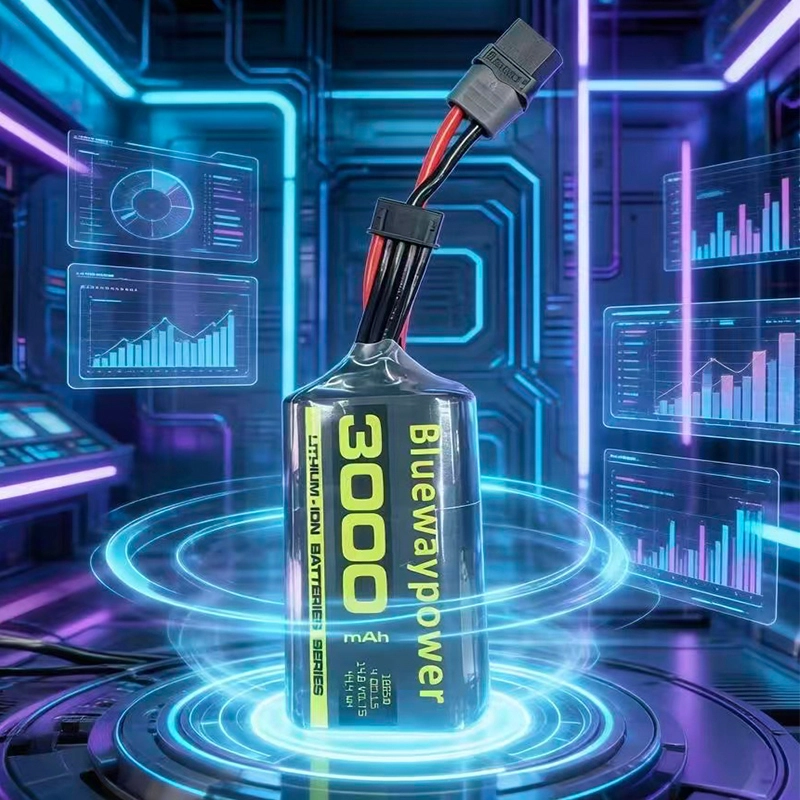
In industrial drone applications such as power inspection, mapping and surveying, agricultural monitoring, emergency response, and infrastructure inspection, battery performance directly affects flight stability and operational efficiency. As a result, more manufacturers are now adopting 21700 5000 battery solutions for industrial UAV systems that require longer endurance, stable discharge capability, and lightweight power structures.
For years, many drone manufacturers believed battery problems could be solved with one simple idea:
Use a bigger battery.
When flight time became too short, they increased capacity. When drones lost power during demanding operations, they added more cells. However, this approach gradually created new problems.
The battery became heavier.
The drone lost maneuverability.
And real flight efficiency barely improved.
Therefore, the industry is now shifting toward smarter UAV battery design instead of oversized battery packs.
Why 21700 Battery Technology Fits Industrial UAV Applications
Compared with older cylindrical cells, 21700 battery technology offers a stronger balance between energy density, thermal stability, and discharge performance.
For industrial UAV systems, this creates several advantages.
Longer Flight Time With Lower Weight
A properly designed 21700 5000 battery can provide stable energy output without dramatically increasing pack size.
This is especially important for:
- Mapping and surveying UAVs
- Power line inspection drones
- Agricultural spraying aircraft
- Emergency response UAV systems
- Security monitoring drones
In these applications, every gram affects flight efficiency. Therefore, lightweight battery structures help improve endurance and operational flexibility.
Better Thermal Stability During Continuous Flights
Industrial drones rarely operate in ideal environments. Instead, they often work in:
- High-temperature outdoor areas
- Cold inspection environments
- Dusty industrial zones
- Long-duration flight missions
Under these conditions, unstable batteries may suffer from voltage drops and overheating.
However, 21700 drone batteries provide better heat dissipation and more stable discharge performance during demanding workloads. As a result, UAV operators can achieve safer and more predictable flight behavior.
Why Intelligent BMS Systems Matter in UAV Battery Design
Many buyers still focus only on battery cells. However, experienced UAV manufacturers understand that battery management systems play an equally important role.
Without proper BMS coordination, even high-quality cells cannot maintain stable operation.
Modern industrial drone battery systems require intelligent management for:
- Voltage balancing
- Temperature monitoring
- Overcharge protection
- Discharge optimization
- Real-time power communication
Because of this, more UAV companies now prefer integrated UAV battery solution providers instead of sourcing cells, BMS modules, and PACK assembly separately.
The Industry Is Moving Toward Integrated UAV Battery Solutions
In the past, battery manufacturing was often divided across multiple suppliers.
One company produced cells.
Another handled BMS programming.
A third factory assembled the final battery pack.
However, this fragmented process often created compatibility issues and inconsistent performance.
Today, more industrial drone battery manufacturers are adopting integrated development models combining:
- Battery cells
- BMS systems
- PACK assembly
within one manufacturing system.
As a result, manufacturers can improve structural consistency, communication efficiency, safety management, and mass production reliability.
How Defond Supports Industrial Drone Battery Development
Shenzhen Defond Technology focuses on integrated UAV battery solutions for both consumer and industrial drone applications.
Founded in 2016, the company provides:
- Customized battery cells
- Self-developed chip-level BMS
- PACK assembly and manufacturing
Its products are widely used in:
- Power inspection UAVs
- Mapping and surveying drones
- Emergency response aircraft
- Industrial UAV systems
One example is the 21700-6S1P-21.6V 5000mAh drone battery pack designed for compact industrial UAV platforms.
Key specifications include:
- Voltage & Capacity: 21.6V 5000mAh
- Connector: XT60
- Weight: 303g
- Size: 75 × 65.2 × 44 mm
- Cell Model: SunPower 21700-50SE
This high energy density drone battery helps reduce aircraft burden while maintaining stable continuous discharge capability during demanding flight operations.
Conclusion
As industrial UAV applications continue expanding across power inspection, aerial mapping, agriculture, and emergency response, battery systems are becoming one of the most important factors affecting drone reliability and flight efficiency.
Instead of simply increasing battery size, manufacturers are now prioritizing energy density, thermal stability, intelligent BMS coordination, and lightweight structural design.
This shift is accelerating the adoption of 21700 5000 battery solutions in modern industrial drone platforms.
With stable discharge performance, improved thermal management, and integrated UAV battery system development, 21700 drone batteries are helping industrial UAV systems achieve longer endurance, safer operation, and more reliable performance in demanding outdoor environments.