

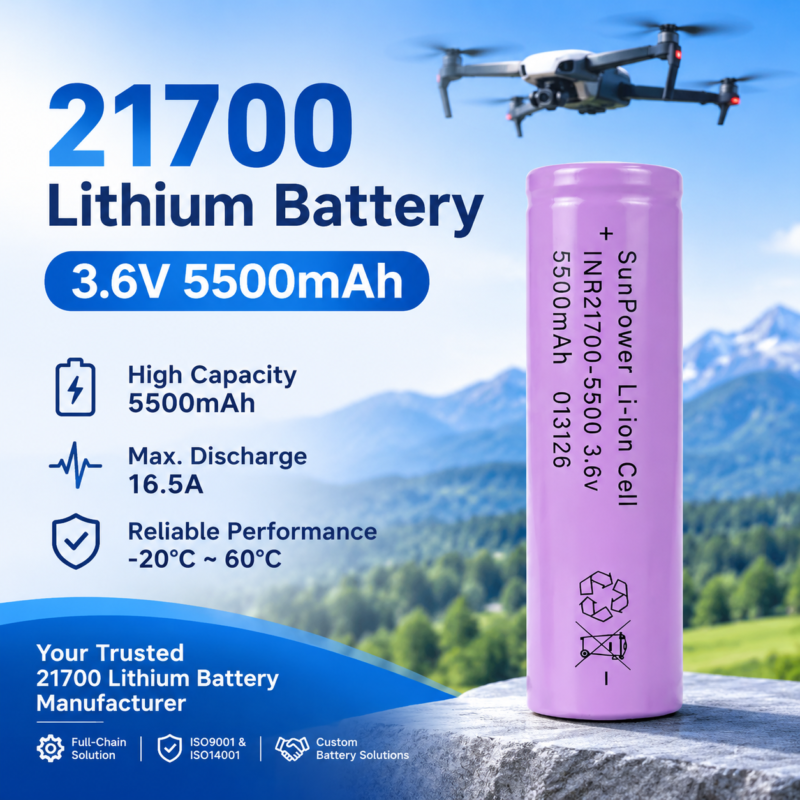
Choosing a reliable 21700 lithium battery manufacturer requires more than comparing nominal capacity. You need to evaluate discharge performance, operating temperature, cell consistency, and the manufacturer’s ability to support your battery development requirements. These factors become particularly important when you integrate lithium-ion cells into drone power systems, industrial equipment, and other demanding applications.
The 21700 Li-ion Cell 3.6V 5500mAh (Model 21700-55P) from Shenzhen Defond Technology Co., Ltd. offers a high-capacity cylindrical cell solution. With a 16.5A maximum continuous discharge current and a 30A pulse discharge capability, this cell provides a combination of capacity and output performance for battery system designers evaluating customized power solutions.
21700 Lithium Battery Manufacturer: Understanding the 5500mAh Cell
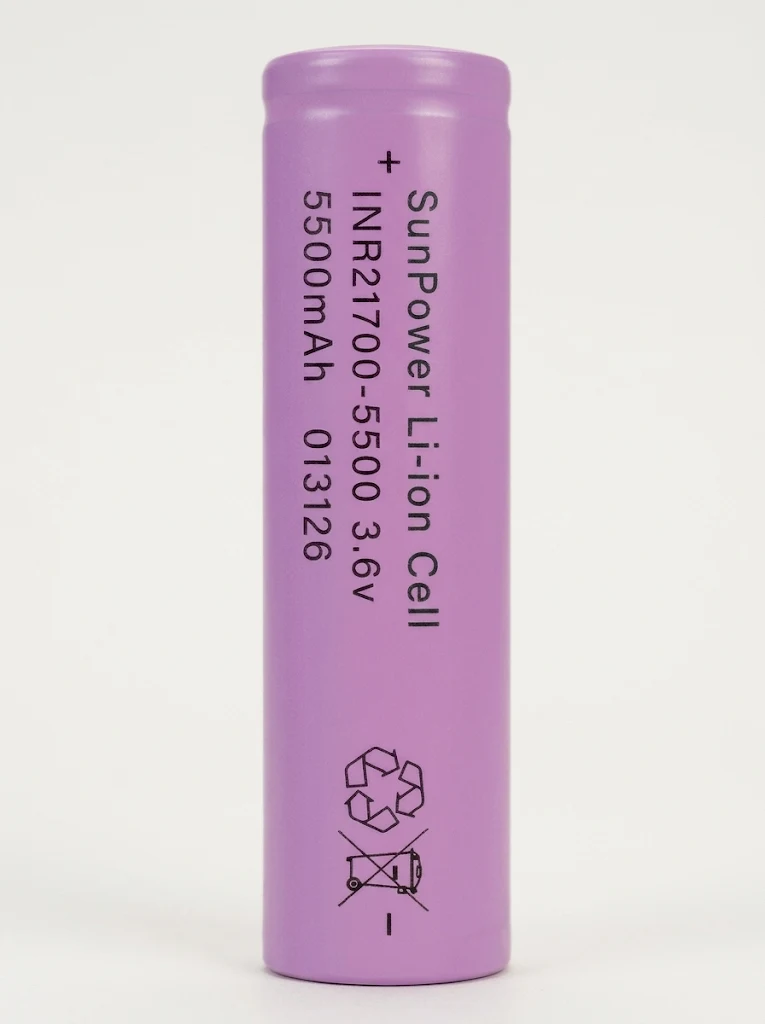
A 21700 lithium-ion cell measures approximately 21mm in diameter and 70mm in length. Compared with smaller cylindrical formats, the 21700 design provides more internal space for active materials, making it suitable for applications that require higher capacity per cell.
Defond’s 21700-55P is designed around the following specifications:
| Parameter | Specification |
|---|---|
| Model | 21700-55P |
| Battery Chemistry | Lithium-ion |
| Nominal Voltage | 3.6V |
| Rated Capacity | 5500mAh |
| Maximum Continuous Discharge Current | 16.5A |
| Maximum Pulse Discharge Current | 30A (2 seconds) |
| Operating Temperature (Ambient) | -20°C to 60°C |
| Cell Format | 21700 Cylindrical |
The 5500mAh capacity provides a nominal energy of approximately 19.8Wh per cell, calculated from its nominal voltage and rated capacity.
The discharge specifications also offer useful design information:
- Capacity: 5500mAh supports applications that prioritize energy storage per cell.
- Continuous output: The maximum continuous discharge current is 16.5A.
- Pulse output: The cell supports a maximum 30A discharge for a 2-second pulse.
- Temperature range: The specified ambient operating range is -20°C to 60°C.
You should consider the actual load profile, cooling conditions, and battery protection requirements when evaluating these specifications for your equipment.
Applications of 21700 5500mAh Lithium-Ion Cells
A high-capacity 21700 lithium battery can support different battery system designs. However, the final suitability depends on the required voltage, current, operating duration, and system configuration.
1. Drone Power Systems
Drone manufacturers need battery solutions that balance energy capacity, weight, and discharge performance. The 21700-55P can be evaluated as a cylindrical cell option for customized UAV battery development.
Potential design considerations include:
- Required flight duration and energy consumption.
- Motor and electronic load requirements.
- Battery weight and structural layout.
- BMS protection and thermal management.
For agricultural drones, power inspection UAVs, and industrial platforms, engineers should verify whether the cell’s continuous and pulse discharge ratings meet the complete system requirements.
2. Industrial Equipment
Industrial equipment often operates under changing loads and environmental conditions. The cell’s specified -20°C to 60°C operating temperature range provides a reference for evaluating its use in equipment designed for different working environments.
3. Customized Lithium Battery Packs
Multiple 21700 cells can be connected in series or parallel to achieve specific voltage and capacity targets.
For example, battery engineers can evaluate different configurations based on:
- Required nominal voltage.
- Target battery capacity.
- Continuous and peak current.
- Available installation space.
- Protection and monitoring requirements.
The 21700-55P is a single battery cell, not a preassembled battery pack. Additional electrical and mechanical design is necessary before integration into an end product.
21700 Lithium-Ion Cell vs. 18650 Battery: Which Should You Choose?
Both 21700 and 18650 are widely used cylindrical lithium-ion battery formats. Your choice should depend on energy requirements, available installation space, and the electrical characteristics of the target application.
| Comparison Factor | 21700 Cell | 18650 Cell |
|---|---|---|
| Approximate Dimensions | 21 × 70mm | 18 × 65mm |
| Physical Size | Larger | Smaller |
| Capacity Potential | Generally higher per cell | Generally lower per cell |
| Installation Space | Requires more space | More compact |
| Typical Design Consideration | Higher capacity per cell | Flexible compact layouts |
The 21700 format is worth considering when you want to reduce the number of individual cells needed to reach a target capacity. In contrast, 18650 cells may offer greater flexibility when your equipment has strict dimensional limitations.
For drone battery development, you should compare the complete pack’s weight, energy density, discharge capability, and thermal performance rather than selecting a cell based on size alone.
How to Select a Reliable 21700 Lithium Battery Manufacturer
Finding a suitable 21700 lithium battery supplier involves evaluating both product specifications and manufacturing capabilities. The following steps can help you narrow down your options.
- Confirm cell specifications: Check nominal voltage, rated capacity, continuous discharge current, pulse discharge capability, and operating temperature.
- Review manufacturing quality: Ask about production controls, inspection procedures, and quality management certifications.
- Evaluate BMS integration: Confirm whether the manufacturer can support battery management systems that match your application.
- Discuss customization requirements: Provide your target voltage, capacity, dimensions, discharge profile, and operating environment.
- Request technical documentation and samples: Review available test reports and conduct application-specific validation before mass production.
Shenzhen Defond Technology Co., Ltd. provides integrated battery development covering cells, self-developed chip-level BMS, and PACK manufacturing. This full-chain capability helps customers coordinate different stages of battery development through one supplier.
Why Choose Shenzhen Defond Technology Co., Ltd.?
Founded in 2016 and headquartered in Shenzhen, Defond specializes in new energy battery solutions, particularly for drone applications.
Its manufacturing and technical capabilities support customers developing both consumer-grade and industrial battery systems.
Key advantages include:
- Full-chain development: Integrated capabilities covering battery cells, BMS, and PACK.
- R&D resources: Technical teams supporting customized battery development and product improvement.
- Quality management: ISO9001 and ISO14001 certified management systems.
- Manufacturing capabilities: Production facilities supporting different project requirements, from small batches to mass production.
- International experience: Products and solutions serving customers across more than 30 countries and regions.
- Application expertise: Battery solutions developed for agriculture, power inspection, and emergency response applications.
Defond also works with specialized R&D resources, including the Jiangsu Sunpower Competitiveness Lab and the North America New Energy R&D Center QUBE, supporting battery technology research and industrialization.
These capabilities give customers access to coordinated technical support when developing customized lithium battery solutions.
Frequently Asked Questions
1. What is the capacity of a 21700 5500mAh lithium battery?
The 21700-55P has a rated capacity of 5500mAh and a nominal voltage of 3.6V. Its calculated nominal energy is approximately 19.8Wh per cell.
2. What is the maximum discharge current of the 21700-55P?
The cell supports a maximum continuous discharge current of 16.5A and a maximum pulse discharge current of 30A for 2 seconds. You should distinguish between continuous and short-duration peak loads when designing a battery system.
3. Can a 21700 lithium-ion cell be customized into a drone battery pack?
Yes. Multiple cells can be integrated into a customized battery pack through suitable series and parallel configurations. The final design requires consideration of voltage, capacity, discharge current, BMS protection, thermal management, and mechanical dimensions.
Conclusion
Selecting the right 21700 lithium battery manufacturer can directly influence your battery system’s performance, reliability, and development efficiency. The Defond 21700-55P offers 3.6V nominal voltage, 5500mAh capacity, 16.5A continuous discharge current, and 30A pulse discharge capability, providing a technical option for customized battery development.
With integrated cell, BMS, and PACK capabilities, Shenzhen Defond Technology Co., Ltd. supports customers looking for coordinated lithium battery development and manufacturing. Whether you are evaluating cylindrical cells for industrial equipment or developing customized drone power systems, matching the cell specifications to your actual application should be the first step.
Request a Technical Quote from Defond
Share your target voltage, capacity, discharge requirements, application, and estimated order quantity with Defond’s engineering team. You can also request available technical specifications and discuss customized cell or battery pack development.