

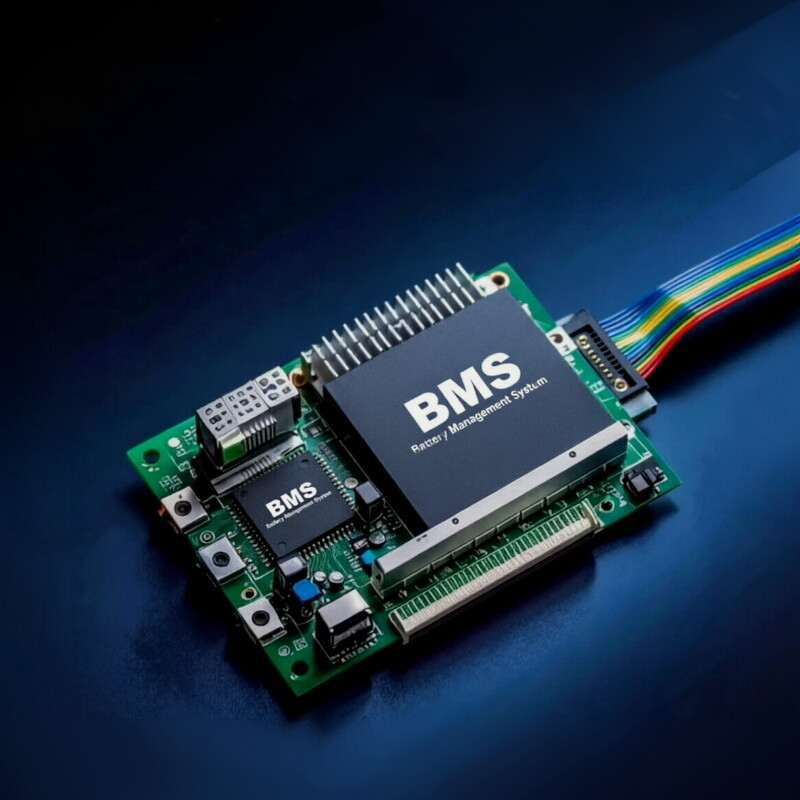

lithium-ion batteries are the heart of a drone, the Battery Management System (BMS) is its “safety brain.” It plays a decisive role in ensuring battery safety, longevity, and flight reliability. Yet, many pilots underestimate the importance of the BMS, not realizing that BMS failure is actually the leading cause of swollen batteries, fires, and explosions. In this article, we will break down the core functions and working principles of drone BMS, explain why it is absolutely essential, and look ahead to future trends—giving you a full picture of this vital technology.
I. Core Functions of a BMS
The functions of a drone’s BMS can be summarized into four main tasks: Monitoring, Protection, Balancing, and Communication.
1. Real-time Monitoring
The BMS uses high-precision sensors to perform high-frequency sampling of multiple key battery parameters:
The BMS uses high-precision sensors to perform high-frequency sampling of multiple key battery parameters:
- Voltage Monitoring: High-frequency sampling (typically over 10Hz) of individual cell and total voltage via voltage sensors, with an accuracy of ±2~5mV. This identifies over-voltage and under-voltage states to prevent overcharging or over-discharging.
- Current Monitoring: Uses Hall effect sensors or shunts to measure charge/discharge current, calculating real-time power and cumulative capacity.
- Temperature Monitoring: NTC temperature sensors are placed at multiple points (on the battery pack surface and inside cells) to monitor temperature distribution. Cooling or shutdown protection is triggered when the temperature exceeds a threshold (typically 60℃).
- SOC Estimation (State of Charge): Estimates the remaining battery capacity based on voltage and current data, typically keeping the error within 5% to provide a basis for flight endurance predictions.
- SOH Assessment (State of Health): Evaluates the battery’s health based on cycle count, capacity degradation rate, and internal resistance changes, prompting users to replace aging batteries.
2. Safety Protection
The BMS integrates multiple protection mechanisms that respond automatically during anomalies. Common functions include overcharge, over-discharge, over-current/short-circuit, over-temperature/under-temperature, and cell voltage deviation protection.
Regarding safety certifications, the BMS response time for overcharge/over-discharge protection is required to be under 200ms, with a voltage threshold accuracy of ±0.05V. In short-circuit simulation tests, the protection circuit must activate in under 1 second, ensuring the battery does not catch fire or explode. Since many thermal runaway incidents are caused by overcharging, over-discharging, or overheating, the BMS is essential in preventing these scenarios.
The BMS integrates multiple protection mechanisms that respond automatically during anomalies. Common functions include overcharge, over-discharge, over-current/short-circuit, over-temperature/under-temperature, and cell voltage deviation protection.
Regarding safety certifications, the BMS response time for overcharge/over-discharge protection is required to be under 200ms, with a voltage threshold accuracy of ±0.05V. In short-circuit simulation tests, the protection circuit must activate in under 1 second, ensuring the battery does not catch fire or explode. Since many thermal runaway incidents are caused by overcharging, over-discharging, or overheating, the BMS is essential in preventing these scenarios.
3. Balancing Management
Although cells with similar capacities and internal resistances are selected during pack assembly, cells within a battery pack rarely age uniformly, leading to discrepancies during use. The BMS uses active or passive balancing technology to equalize voltage differences between cells, thereby improving safety and extending the overall lifespan of the battery pack.
Although cells with similar capacities and internal resistances are selected during pack assembly, cells within a battery pack rarely age uniformly, leading to discrepancies during use. The BMS uses active or passive balancing technology to equalize voltage differences between cells, thereby improving safety and extending the overall lifespan of the battery pack.
- Active Balancing: Actively adjusts voltage differences by transferring energy from high-voltage cells to low-voltage ones, equalizing cell voltages.
- Passive Balancing: Consumes the excess energy of high-voltage cells through resistors to equalize voltages.
Regardless of the method, balancing prevents voltage discrepancies between cells, effectively avoiding overcharging or over-discharging.
4. Intelligent Communication
Modern BMS units use various communication protocols to transmit real-time battery status to the drone’s flight controller, enabling in-flight status feedback and power decision-making. Common protocols include:
Modern BMS units use various communication protocols to transmit real-time battery status to the drone’s flight controller, enabling in-flight status feedback and power decision-making. Common protocols include:
- I2C: Commonly used in consumer and small drones; low power consumption, allowing multiple devices to share the same communication bus.
- CAN Bus: Used in industrial, commercial, and high-performance applications; features high-speed communication, low latency, and high reliability in noisy environments.
- SMBus: A subset of I2C designed specifically for power management, common in consumer drones.
- UART: Low cost and simple to implement; some consumer drones use UART for basic battery status updates.
- BLE (Bluetooth Low Energy): Enables wireless communication for real-time battery monitoring via smartphones or tablets.
II. Working Principle of a BMS
The working principle of a BMS can be understood as a closed-loop system of “Acquisition → Analysis → Decision → Execution”.
Step 1: High-Speed Data Acquisition
The core of the BMS is a high-precision sensor network. Taking the industry-advanced NXP RDDRONE-BMS772 solution as an example, the system performs ADC conversion on different battery voltages and currents, enabling precise Coulomb counting and temperature measurement. The MR-BMS771 solution, designed for next-generation drone applications, is further upgraded to support the independent management of 7 to 14 battery cells.
The core of the BMS is a high-precision sensor network. Taking the industry-advanced NXP RDDRONE-BMS772 solution as an example, the system performs ADC conversion on different battery voltages and currents, enabling precise Coulomb counting and temperature measurement. The MR-BMS771 solution, designed for next-generation drone applications, is further upgraded to support the independent management of 7 to 14 battery cells.
Step 2: Algorithmic Analysis and State Estimation
The collected data is processed by the BMS microcontroller (MCU). Core algorithms include SOC (State of Charge) estimation and SOH (State of Health) assessment. SOC estimation typically combines the Ampere-hour integration method with the Open Circuit Voltage (OCV) method, while SOH assessment judges battery health through cycle counts, capacity degradation, and internal resistance changes.
The collected data is processed by the BMS microcontroller (MCU). Core algorithms include SOC (State of Charge) estimation and SOH (State of Health) assessment. SOC estimation typically combines the Ampere-hour integration method with the Open Circuit Voltage (OCV) method, while SOH assessment judges battery health through cycle counts, capacity degradation, and internal resistance changes.
Step 3: Protection Decision and Circuit Control
When algorithms detect anomalies, the BMS cuts off the circuit via switching components like MOSFETs. In cases of over-current or excessive temperature, the BMS instantly isolates the battery pack to prevent catastrophic failures.
When algorithms detect anomalies, the BMS cuts off the circuit via switching components like MOSFETs. In cases of over-current or excessive temperature, the BMS instantly isolates the battery pack to prevent catastrophic failures.
Step 4: Communication Feedback and Closed-loop Regulation
The BMS transmits data such as remaining capacity, health diagnostics, temperature status, and fault alerts to the flight control system via interfaces like CAN, SMBus, or UART. This closed-loop system allows the flight controller to adjust power strategies in real-time, ensuring safe and efficient flight.
The BMS transmits data such as remaining capacity, health diagnostics, temperature status, and fault alerts to the flight control system via interfaces like CAN, SMBus, or UART. This closed-loop system allows the flight controller to adjust power strategies in real-time, ensuring safe and efficient flight.
III. The Necessity of a BMS
1. Essential for Battery Lifespan and Safety
Drone batteries are evolving towards higher voltages (12S to 24S), higher capacities, and higher discharge rates (over 10C), which increases the risk of thermal runaway. Although a BMS slightly reduces the battery’s energy density, its contribution to safety is immense. It prevents overcharging, over-discharging, and overheating, significantly extending battery lifespan and reducing the risk of thermal runaway under extreme conditions.
Drone batteries are evolving towards higher voltages (12S to 24S), higher capacities, and higher discharge rates (over 10C), which increases the risk of thermal runaway. Although a BMS slightly reduces the battery’s energy density, its contribution to safety is immense. It prevents overcharging, over-discharging, and overheating, significantly extending battery lifespan and reducing the risk of thermal runaway under extreme conditions.
2. Adaptability in Harsh Flight Environments
Drones often face harsh environments such as high altitudes, extreme cold, high humidity, and high vibration. BMS optimization allows batteries to operate in these extremes; for instance, industrial drones can expand their operating temperature range by integrating temperature control modules.
Drones often face harsh environments such as high altitudes, extreme cold, high humidity, and high vibration. BMS optimization allows batteries to operate in these extremes; for instance, industrial drones can expand their operating temperature range by integrating temperature control modules.
3. Requirements for High-Value Equipment and Critical Missions
When drones carry expensive payloads like LiDAR sensors or medical supplies, the predictive safety features of a BMS become crucial. An intelligent BMS can identify changes in battery health and provide early warnings before potential failures occur, preventing flight accidents. For scenarios like industrial inspection, logistics delivery, and emergency rescue, a BMS has shifted from an “optional configuration” to a “mandatory requirement.”
When drones carry expensive payloads like LiDAR sensors or medical supplies, the predictive safety features of a BMS become crucial. An intelligent BMS can identify changes in battery health and provide early warnings before potential failures occur, preventing flight accidents. For scenarios like industrial inspection, logistics delivery, and emergency rescue, a BMS has shifted from an “optional configuration” to a “mandatory requirement.”
IV. Future Development Trends
1. AI-Driven: From “Passive Protection” to “Active Prediction”
AI-driven BMS is revolutionizing drone battery management. By monitoring battery health in real-time with machine learning algorithms, AI BMS can predict maintenance needs, extend battery life by 25%, and improve fleet efficiency by 20%. In the logistics sector, drone fleets with integrated AI BMS have seen a 40% reduction in failure rates. The future BMS will fully transition from “passive protection” to “active prediction.”
AI-driven BMS is revolutionizing drone battery management. By monitoring battery health in real-time with machine learning algorithms, AI BMS can predict maintenance needs, extend battery life by 25%, and improve fleet efficiency by 20%. In the logistics sector, drone fleets with integrated AI BMS have seen a 40% reduction in failure rates. The future BMS will fully transition from “passive protection” to “active prediction.”
2. High Voltage, Miniaturization, and Low-Power Integration
Drone BMS is moving towards greater integration: adopting high-precision multi-channel sampling chips, highly integrated MCU + Analog Front End (AFE), ultra-low standby power consumption (<50μA), and fast wake-up mechanisms, while supporting compact PCB layouts and custom-shaped structures. As drone batteries upgrade to high-voltage systems like 12S to 24S, the BMS must support higher sampling accuracy for voltage, current, and temperature, along with faster data response speeds.
Drone BMS is moving towards greater integration: adopting high-precision multi-channel sampling chips, highly integrated MCU + Analog Front End (AFE), ultra-low standby power consumption (<50μA), and fast wake-up mechanisms, while supporting compact PCB layouts and custom-shaped structures. As drone batteries upgrade to high-voltage systems like 12S to 24S, the BMS must support higher sampling accuracy for voltage, current, and temperature, along with faster data response speeds.
3. Boom in the Low-Altitude Economy and Rapid Market Growth
The low-altitude economy is becoming a new frontier in global industrial competition. China’s low-altitude economy market size is projected to reach 1.5 trillion yuan in 2025 and potentially 3.5 trillion yuan by 2035. The drone battery BMS market is expected to exceed $1.5 billion by 2027, with an annual growth rate of over 25%. With the low-altitude economy being emphasized in government work reports for consecutive years, power batteries—as the core energy for eVTOLs and large drones—directly determine the pace of industrialization. Future growth will focus on complex BMS customization for high-voltage, high-capacity systems, AI-integrated BMS, and cloud-based remote management.
The low-altitude economy is becoming a new frontier in global industrial competition. China’s low-altitude economy market size is projected to reach 1.5 trillion yuan in 2025 and potentially 3.5 trillion yuan by 2035. The drone battery BMS market is expected to exceed $1.5 billion by 2027, with an annual growth rate of over 25%. With the low-altitude economy being emphasized in government work reports for consecutive years, power batteries—as the core energy for eVTOLs and large drones—directly determine the pace of industrialization. Future growth will focus on complex BMS customization for high-voltage, high-capacity systems, AI-integrated BMS, and cloud-based remote management.
4. Cloud Management and Fleet Collaboration
Industrial-grade BMS is evolving from single-unit management to fleet-level cloud collaboration. Through data logging and cloud uploads, operators can achieve battery lifecycle management and predictive maintenance, supporting features like multi-battery parallel management and primary/backup switching. This trend will upgrade drone energy management from “single-point intelligence” to “global intelligence.”
Industrial-grade BMS is evolving from single-unit management to fleet-level cloud collaboration. Through data logging and cloud uploads, operators can achieve battery lifecycle management and predictive maintenance, supporting features like multi-battery parallel management and primary/backup switching. This trend will upgrade drone energy management from “single-point intelligence” to “global intelligence.”
The BMS is to a drone battery what the brain is to the human body—it is not only the guardian of safety but also the dispatcher of performance and the manager of lifespan. As technology advances, battery cells from various manufacturers are becoming increasingly similar, turning cells into more of a standardized commodity. At this point, the role of the BMS will become even more critical, serving as a key differentiator in product competitiveness.