
Choosing a 21700 li ion cell requires more than checking its nominal voltage and capacity. You also need to consider discharge current, operating temperature, runtime requirements, and compatibility with your battery system. An unsuitable cell may limit equipment performance or require changes to your power design.
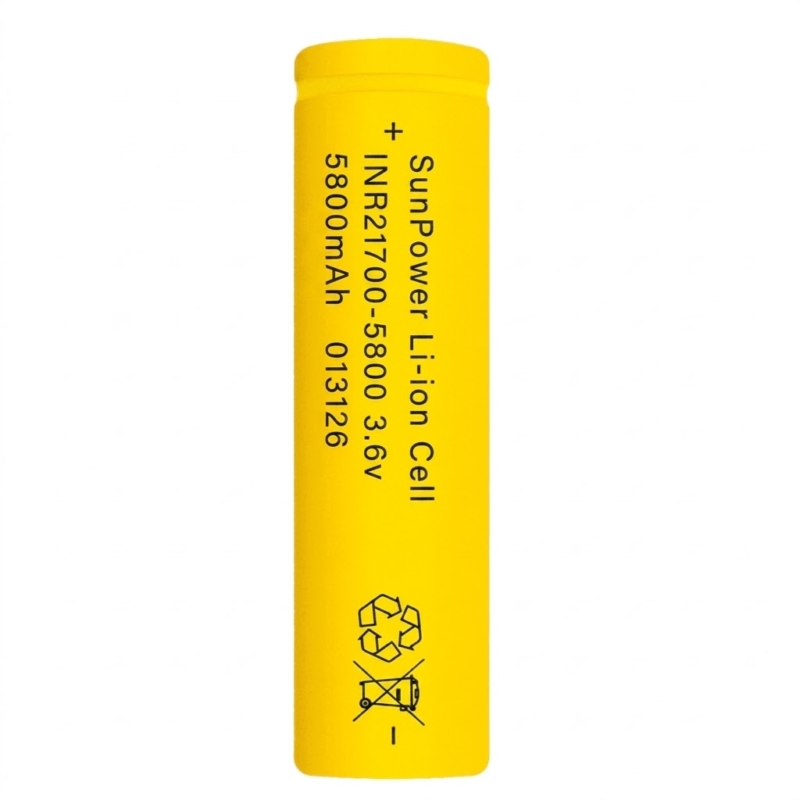
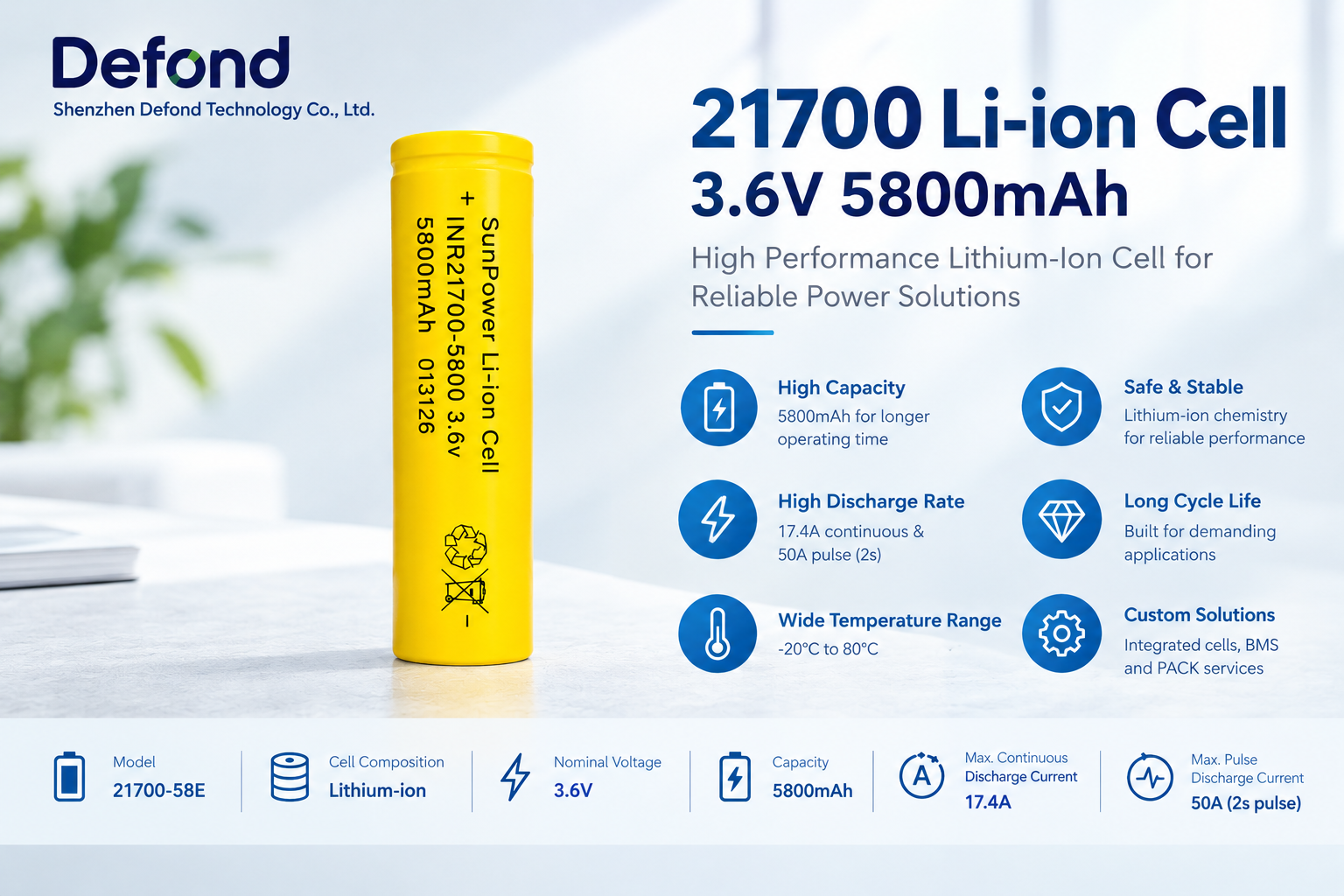
The 21700 Li-ion Cell 3.6V 5800mAh, Model 21700-58E, from Shenzhen Defond Technology Co., Ltd. offers a cylindrical lithium-ion cell for applications that require substantial capacity and defined discharge performance. It provides a nominal voltage of 3.6V, a capacity of 5800mAh, and a maximum continuous discharge current of 17.4A. Its specified pulse discharge current reaches 50A for two seconds, giving you key parameters to evaluate when selecting a cell for your application.
21700 Li Ion Cell: Key Specifications
Before choosing a battery cell, compare its electrical characteristics with your equipment’s power requirements. The following specifications describe the 21700-58E model.
| Parameter | Specification |
|---|---|
| Product name | 21700 Li-ion Cell |
| Model | 21700-58E |
| Cell chemistry | Lithium-ion |
| Nominal voltage | 3.6V |
| Rated capacity | 5800mAh (5.8Ah) |
| Maximum continuous discharge current | 17.4A |
| Maximum pulse discharge current | 50A for 2 seconds |
| Operating ambient temperature | -20°C to 80°C |
These figures help you assess whether the cell fits your power design. However, the operating temperature range does not establish that the cell can deliver its full rated capacity or maximum discharge current at every temperature.
Similarly, the 50A pulse rating applies to a specified two-second pulse, not continuous operation. You should confirm the complete discharge conditions, charging limits, and protection requirements with your supplier before finalizing your design.
Why Consider a 5800mAh 21700 Lithium-Ion Cell?
1. Capacity for Longer Operating Periods
With a rated capacity of 5800mAh, this 21700 lithium-ion cell may suit equipment that needs a balance between energy capacity and available current. Actual runtime depends on the connected load, operating temperature, system efficiency, and usable battery capacity.
For example, if your application draws an average current of 2A, a simplified estimate is:
Estimated runtime = 5.8Ah ÷ 2A = 2.9 hours
This is a theoretical estimate rather than a guaranteed operating time. Real-world results will vary with discharge conditions, cutoff voltage, and battery management settings.
2. Defined Continuous and Pulse Discharge Performance
The 21700-58E supports a maximum continuous discharge current of 17.4A and a maximum pulse discharge current of 50A for two seconds. These ratings help you evaluate applications with different steady-state and short-duration current demands.
When selecting a cell, consider:
- Continuous load: Check whether the normal operating current remains within the specified limit.
- Peak load: Verify the duration and frequency of current surges.
- Thermal conditions: Evaluate heat generation under your actual load profile.
- Protection design: Ensure that the BMS, wiring, connectors, and other components support the intended current.
A suitable system design must account for the entire electrical path, not just the cell’s maximum discharge rating.
3. Temperature Considerations
The specified ambient operating temperature range is -20°C to 80°C. This range provides an initial reference for applications exposed to changing environmental conditions.
However, low-temperature discharge performance, high-temperature aging, charging limits, and thermal management requirements should be assessed separately. If you plan to use the cell in outdoor equipment or industrial environments, request the relevant test data for your operating conditions.
Potential Applications of the 21700 Battery Cell
A 21700 cylindrical lithium-ion cell can be evaluated for different portable and industrial power applications, depending on its verified performance and the final battery configuration.
Potential application areas include:
- Drone power systems: Evaluate capacity, weight, current demand, and flight-time requirements before integrating the cell into a drone battery pack.
- Industrial equipment: Consider the cell for portable equipment that needs a defined voltage and discharge capability.
- Portable power systems: Assess whether the capacity and discharge characteristics meet the device’s runtime and peak-load requirements.
- Customized battery packs: Evaluate the cell as a potential component in a pack designed around specific voltage, capacity, and protection requirements.
For drone applications in particular, you should verify cell weight, discharge curves, cycle-life data, vibration resistance, and the complete pack configuration. The specifications listed here alone do not establish suitability for every drone or high-power application.
21700 Li Ion Cell vs. 18650 Battery Cell
Both formats are used in lithium-ion battery systems, but they differ in physical dimensions and the available specifications of individual models.
| Comparison factor | 21700-58E | 18650 cell |
|---|---|---|
| Cell format | 21700 cylindrical | 18650 cylindrical |
| Capacity | 5800mAh | Depends on model |
| Nominal voltage | 3.6V | Depends on chemistry and model |
| Continuous discharge | Up to 17.4A | Depends on model |
| Pulse discharge | 50A for 2 seconds | Depends on model |
| Selection priority | Capacity, current, and available space | Device compatibility and power requirements |
The 21700-58E offers a stated capacity of 5800mAh, but you should not assume every 21700 cell outperforms every 18650 cell. Compare individual datasheets, dimensions, weight, thermal behavior, and system-level requirements before making a decision.
How to Select the Right 21700 Lithium-Ion Cell
Follow these steps to evaluate whether the 21700-58E meets your requirements.
- Define your electrical requirements. Specify nominal voltage, average current, peak current, and expected runtime.
- Check environmental conditions. Identify the expected ambient temperature and the cell’s thermal operating conditions.
- Evaluate pack compatibility. Confirm cell dimensions, connection methods, series-parallel configuration, and BMS requirements.
- Request supporting documentation. Obtain the datasheet, charging specifications, discharge curves, cycle-life results, and applicable safety test reports.
- Validate the design. Test the proposed configuration under representative loads and environmental conditions before deployment.
Shenzhen Defond Technology Co., Ltd. specializes in integrated drone battery solutions covering cells, BMS, and PACK manufacturing. The company reports ISO 9001 and ISO 14001 certifications and provides customized battery development for consumer and industrial drone applications. Discuss your technical requirements with Defond to determine the appropriate cell and system configuration.
FAQ
1. What is the capacity of the 21700-58E cell?
The 21700-58E has a rated capacity of 5800mAh, equivalent to 5.8Ah, and a nominal voltage of 3.6V. Actual usable capacity depends on operating and discharge conditions.
2. Can the 21700-58E discharge at 50A continuously?
No. The specified maximum continuous discharge current is 17.4A. The 50A rating applies to a two-second pulse and should not be treated as a continuous current rating.
3. Is the 21700-58E suitable for drone batteries?
It may be a candidate for evaluation in drone battery systems, but suitability depends on weight, current demand, voltage configuration, thermal performance, and flight-time targets. Confirm the relevant technical data and pack-level requirements with Defond before integration.
Conclusion
The 21700 li ion cell 21700-58E combines a 3.6V nominal voltage, 5800mAh rated capacity, 17.4A maximum continuous discharge current, and 50A two-second pulse discharge capability. These specifications provide a starting point for evaluating portable equipment, industrial systems, and potential drone battery applications. By matching the cell’s verified performance to your electrical, thermal, and mechanical requirements, you can make a more informed battery selection with support from Shenzhen Defond Technology Co., Ltd.
Request a Technical Quote from Defond
Visit the 21700 Li-ion Cell product page to submit your requirements. Include your target quantity, application, operating temperature, continuous and peak current, and intended battery configuration so the team can assess your project needs.